

Have you seen Dado À while reading Portuguese? You may wonder what these two small words mean. They look simple. Yet their use can change based on the sentence around them.
Dado À can help describe a person and their natural habits. A related form can also appear when talking about a situation. This is why new Portuguese learners may feel confused at first.
In this 2026 guide we will make things easy. We will learn the meaning of Dado À and its grammar. We will also see why à has an accent and how different forms work.
What Does Dado À Mean?
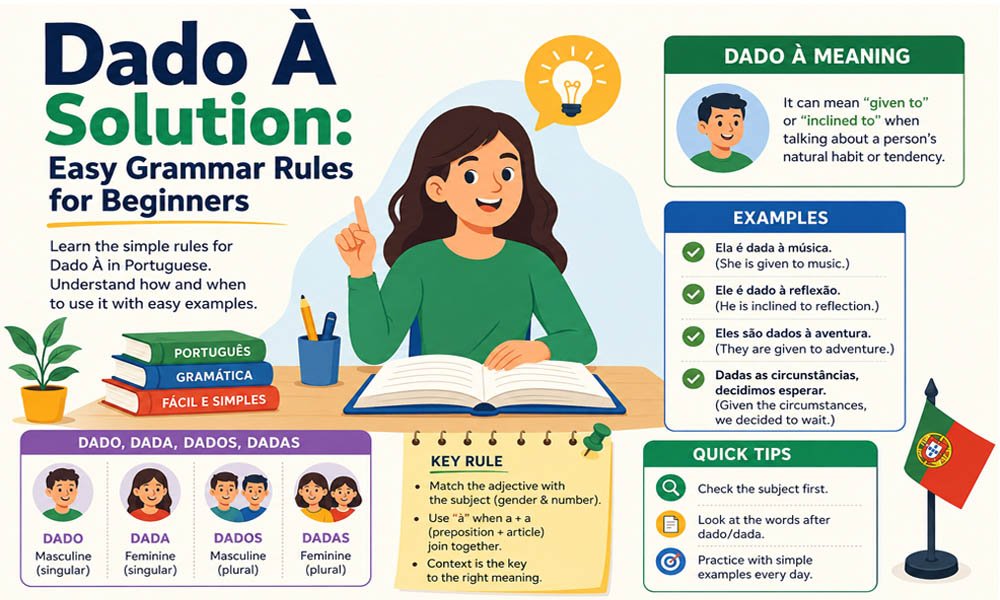
In one common use Dado À describes a natural habit or tendency. It can show that someone often likes or does something. The idea is close to the English words “given to” or “inclined to.”
Think about a person who loves music. Music is a big part of her life. In Portuguese you may see “Ela é dada à música.” It suggests that she is naturally drawn to music.
The exact English meaning can change with context. Sometimes “inclined to” sounds best. At other times “given to” or “prone to” works better. Looking at the whole sentence helps you find the right meaning.
How Dado À Works in Portuguese
The word dado is linked to the Portuguese verb dar. The basic meaning of dar is “to give.” Yet dado can have other jobs when it appears in a sentence.
One use is found in phrases about a person’s habits. Imagine a man who often spends time thinking about life. A sentence may describe him as dado à reflexão. This tells us that reflection is natural for him.
Do not try to translate every word alone. Portuguese and English do not always build ideas in the same way. Read the full sentence first. This simple habit can make Dado À much easier to understand.
Easy Dado À Grammar Rules
When dado describes someone it may change to match that person. For one male subject the form is dado. For one female subject the form becomes dada.
The same rule works with groups. Dados is a masculine plural form. Dadas is a feminine plural form. These changes are normal because Portuguese words often match gender and number.
For example you may see “Ela é dada à música.” With a male subject you may see “Ele é dado à reflexão.” Checking the subject first makes choosing the right form much easier.
Why Dado À Uses the À Accent
The mark over à is important. In Portuguese à can be made when the preposition a meets the feminine article a. The two words join and become à.
This joining is called crase in Portuguese grammar. The name may sound hard. The basic idea is not. Think of two small parts joining together to make one written form.
However à does not appear after dado every time. You may see dado a aventuras but dado à música. The noun and its article help decide whether the accent is needed.
Dado À vs Dada A
Here is an important point for beginners. Dado à and dada a can appear in sentences that do different jobs. They should not always be treated as one fixed phrase.
Take “Ela é dada à música.” Here dada describes the woman. It tells us about her interest or tendency. The word changes to match the female subject.
Now look at “Dada a situação decidimos esperar.” This means “Given the situation we decided to wait.” Here the phrase introduces a situation that was considered before the choice was made.
Knowing this difference can stop many grammar mistakes. Ask what dado or dada is doing in the sentence. Is it describing someone? Or does it mean something like “given” before a fact or situation?
How to Use Dado À Correctly
A good first step is to find the subject. If you are describing one man you may need dado. If you are describing one woman you may need dada. Groups can require dados or dadas.
Next look at what comes after the word. Do not add à just because you used dado. Check whether the following noun takes the feminine article and whether the preposition and article need to join.
Finally think about the meaning. Ask yourself what the sentence is saying. If it describes a natural tendency then ser dado a may fit. If it introduces a fact or condition then you may be dealing with the separate “given” construction.
Simple Dado À Examples
Examples can make Dado À much easier to learn. You can see the grammar in action. You can also see how the meaning changes with the person and the words around it.
For example you may say “Ela é dada à música.” This tells us that she has a natural interest in music. You may also see “Ele é dado à reflexão.” This means he often likes deep thought.
Plural forms work in the same way. “Eles são dados à aventura” can describe men or a mixed group that enjoys adventure. “Elas são dadas à arte” can describe women who are naturally drawn to art.
Dado À Meaning in English
There is no single English phrase that matches Dado À in every sentence. The best meaning depends on how the Portuguese sentence is built. This is why context is so important.
When talking about a person you may translate it as “given to” or “inclined to.” In some cases “prone to” also works. For example a person who worries often may be described as being prone to worry.
A different meaning appears in “Dada a situação.” Here the English meaning is usually “given the situation” or “considering the situation.” This is why learners should never depend on one translation alone.
Dado À and Similar Portuguese Phrases
Portuguese has several phrases that may look similar to Dado À at first. One common example is devido a. It usually means “due to” and helps explain why something happened.
Another simple phrase is por causa de. It means “because of” and is common in normal speech. For example “Por causa da chuva ficamos em casa” means that we stayed home because of the rain.
You may also find em virtude de in more formal writing. Graças a means “thanks to” and often points to a good result. These phrases mainly show cause. They do not always replace ser dado a when describing a person.
Common Dado À Mistakes
One common mistake is forgetting to match dado with the person being described. Saying “Ela é dado” does not match a female subject. In this type of sentence the correct form is “Ela é dada.”
Another mistake is adding à every time the word dado appears. Remember that the accent has a grammar job. You should not think of Dado À as two words that must always stay together.
Some learners also use it whenever they want to say “because of.” That can lead to strange sentences. Devido a or por causa de may be better when you simply want to give a cause.
Easy Ways to Remember Dado À
You do not need to learn many hard rules at once. Start by asking one simple question. Who or what is being described? The answer helps you choose between dado and dada.
Next check the word after a. If the grammar calls for the preposition a plus the feminine article a then they join as à. This small check can stop many mistakes.
Practice also makes a big difference. Write short examples about people you know. You might describe someone who loves music or reading. Simple real-life ideas make grammar easier to remember.
Why Learning Dado À Helps Your Portuguese
Learning Dado À can help you understand more than one small expression. It teaches you to notice gender and number. It also helps you understand how a and à can work differently.
This knowledge can help when you read Portuguese too. You may find similar forms in articles and stories. Instead of stopping at every sentence you can look at the context and work out what the writer means.
It can also make your own Portuguese clearer. You will know when you are describing a natural tendency and when you are talking about a given situation. That small difference can make your sentences sound much better.
Conclusion
Dado À may look confusing when you first see it. Yet the main rules become simple when you break them into small parts. You first need to look at the subject and then check the words around the expression.
When dado describes a person it can show a natural habit or tendency. Forms such as dado and dada change to match the subject. Their plural forms are dados and dadas.
Also remember that à is not always required. It comes from the joining of the preposition a and the feminine article a. A phrase such as “Dada a situação” is another construction and should not be confused with “ser dado a.”
The best way to improve is to keep practicing. Read short Portuguese sentences and look at how each form is used. Soon Dado À will feel much easier and you will be able to understand it with more confidence.
(FAQs)
What does Dado À mean in English?
Dado À can mean “given to” or “inclined to” when it describes a person. Sometimes “prone to” also works. The right English meaning depends on the full sentence.
When should I use dado or dada?
Use dado when the adjective describes one male subject. Use dada for one female subject. For groups the forms can become dados and dadas.
Why does Dado À have an accent?
The accent appears when the preposition a joins with the feminine article a. Together they form à. This is known as crase in Portuguese grammar.
Is Dada a situação the same as Dado À?
No. “Dada a situação” means something like “given the situation.” It introduces a fact or condition. Ser dado a can instead describe a person’s natural habit or tendency.
Is Dado À the same as devido a?
Not always. Devido a normally means “due to.” It gives a reason for something. Ser dado a can describe what someone naturally likes or tends to do.
Can Dado À describe habits?
Yes. It can describe a natural habit or tendency. For example someone may be dado à reflexão if they often enjoy thinking and reflecting.
What are the plural forms of dado and dada?
The masculine plural is dados. The feminine plural is dadas. The correct form depends on the people or things being described.
Is à always used after dado?
No. This is an important rule. Whether you use a or à depends on the grammar of the words that follow. You should not add the accent automatically.
What is a common Dado À mistake?
A common mistake is treating Dado À as one fixed phrase. Learners may also forget gender agreement or use à where only a is needed.
How can beginners learn Dado À easily?
Start with short examples. Check the subject first. Then look at the words after dado or dada. Regular reading and simple practice will make the rules easier to remember.
You might also enjoy: Boelis: A Smart Solution for Better Work and Daily Life